
Few judges in American history combined philosophy, intellect, and legal influence as powerfully as Oliver Wendell Holmes Jr..
Known as:
“The Great Dissenter”
Holmes became one of the most respected legal minds ever to sit on the U.S. Supreme Court. His ideas transformed how lawyers, judges, and scholars understood the law itself.
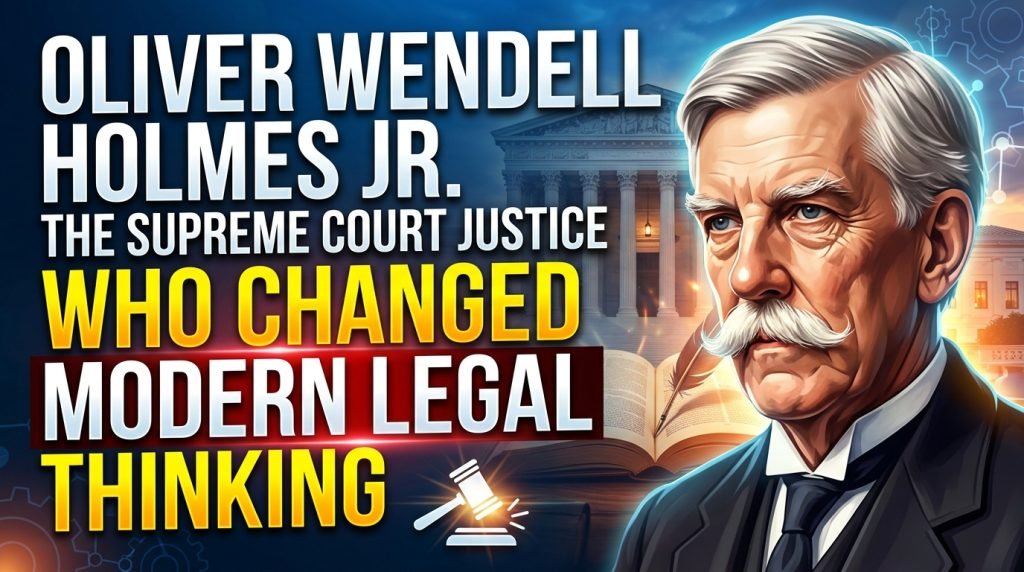
More than just a judge, Holmes was:
- A Civil War veteran
- A legal philosopher
- A constitutional thinker
- One of the architects of modern American jurisprudence
Even today, his words continue to shape debates about free speech, democracy, and judicial power.
Oliver Wendell Holmes Jr.
- Born: March 8, 1841, Boston, Massachusetts
- Died: March 6, 1935, Washington, D.C.
- Supreme Court Tenure: 1902–1932
- Appointed By: Theodore Roosevelt
- Most Famous Book: The Common Law
- Nickname: “The Great Dissenter”
A Young Man Shaped by War
Holmes was born into a prominent Boston family.
His father:
Oliver Wendell Holmes Sr.
was a famous physician, poet, and intellectual.
Holmes studied at:
Harvard University
but his life changed dramatically during the:
American Civil War
He volunteered for the Union Army and fought in several brutal battles.
During the war:
- He was wounded three separate times
- Nearly died in combat
- Witnessed the harsh realities of human conflict
These experiences deeply influenced his later view that:
Law must deal with real human experience — not abstract theory.
From Soldier to Legal Scholar
After the war, Holmes attended:
Harvard Law School
graduating in 1866.
He later became a lawyer, legal scholar, and editor of the:
American Law Review
But Holmes truly gained fame through his groundbreaking book:
The Common Law
In it, he wrote one of the most famous lines in legal history:
“The life of the law has not been logic; it has been experience.”
This idea challenged traditional legal thinking.
Holmes argued that:
- Laws evolve with society,
- changing social realities matter,
- and judges must understand practical consequences.
His philosophy later inspired:
- Legal realism
- Modern constitutional theory
- Pragmatic legal interpretation
Joining the Supreme Court
In 1902, President Theodore Roosevelt appointed Holmes to the U.S. Supreme Court.
He served for:
Nearly 30 years
becoming one of the longest-serving and most influential justices in American history.
Holmes became famous for:
- Short, elegant opinions
- Sharp reasoning
- Intellectual independence
Judicial Restraint and Democracy
Unlike judges who aggressively overturned laws, Holmes believed courts should usually respect decisions made by elected lawmakers.
This philosophy became known as:
Judicial Restraint
He believed:
- Democracies should generally govern themselves,
- even when judges personally disagreed with policies.
This approach strongly influenced twentieth-century constitutional law.
Free Speech and the “Clear and Present Danger” Test
One of Holmes’s most famous decisions came in:
Schenck v. United States
The case involved anti-war speech during World War I.
Holmes introduced the:
“Clear and Present Danger” Test
He argued that free speech could only be restricted when it posed an immediate and serious threat.
This principle became a major foundation of modern:
- First Amendment law
- Free speech jurisprudence
The Marketplace of Ideas
Later that same year, Holmes wrote a legendary dissent in:
Abrams v. United States
There, he defended the idea that:
- Truth emerges through open public debate,
- not government censorship.
This became known as:
The “Marketplace of Ideas”
Today, this concept remains central to American free-expression philosophy.
Why Was He Called “The Great Dissenter”?
Holmes often wrote dissents that later became more influential than majority opinions.
Although he sometimes lost legal battles at the time, his reasoning shaped future generations of judges and scholars.
His dissents were admired for:
- Intellectual depth
- Literary elegance
- Long-term constitutional vision
That’s why he earned the title:
“The Great Dissenter”
A Lasting Legacy
Oliver Wendell Holmes Jr. helped transform American legal thought from rigid formalism toward practical realism.
His influence can still be seen in:
- Constitutional interpretation
- Free speech law
- Judicial philosophy
- Legal education
Even today, lawyers and judges continue quoting Holmes more than almost any other justice in U.S. history.
Final Thoughts
Oliver Wendell Holmes Jr. was more than a Supreme Court justice.
He was:
- A soldier shaped by war
- A philosopher of law
- A defender of democratic governance
- A pioneer of modern constitutional thought
Through his powerful ideas and unforgettable writing, Holmes helped redefine how America understands law, liberty, and the role of the courts.
And nearly a century after his death, his influence remains deeply woven into the foundation of American jurisprudence.
Leave a Reply