
Long before debates about digital surveillance, corporate power, and personal privacy became global issues, Louis Brandeis was already warning America about them.
Known as:
“The People’s Lawyer”
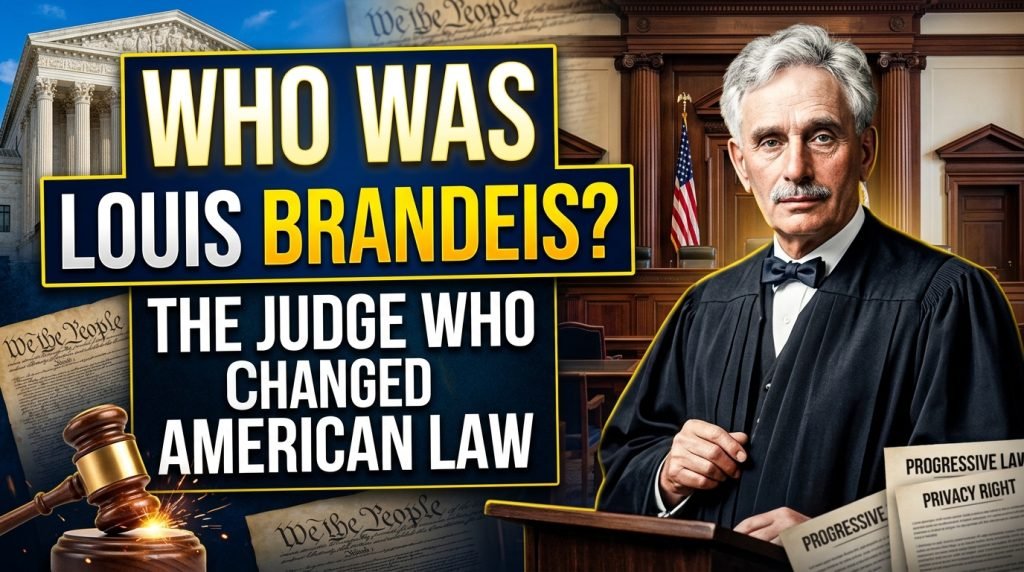
Brandeis became one of the most influential progressive thinkers in American legal history. He believed the law should protect ordinary citizens—not just powerful corporations and political elites.
As a lawyer, scholar, and Supreme Court justice, Brandeis transformed constitutional law through groundbreaking ideas about:
- Privacy
- Free speech
- Democracy
- Corporate regulation
- Judicial restraint
Even today, many modern legal debates still echo his ideas.
Louis Brandeis
- Full Name: Louis Dembitz Brandeis
- Born: November 13, 1856, Louisville, Kentucky
- Died: October 5, 1941, Washington, D.C.
- Supreme Court Tenure: 1916–1939
- Education: Harvard Law School
- Appointed By: Woodrow Wilson
- Known For: The “Brandeis Brief” and modern privacy law
A Brilliant Young Legal Mind
Brandeis was born to Jewish immigrant parents from Bohemia, a region in Central Europe.
From an early age, he showed extraordinary intelligence.
At only:
20 years old
he graduated first in his class from:
Harvard Law School
His academic success quickly turned him into one of America’s most respected young lawyers.
“The People’s Lawyer”
While many attorneys focused on wealthy clients, Brandeis became famous for defending ordinary citizens and public interests.
He fought for:
- Fair labor laws
- Consumer protection
- Workers’ rights
- Honest business practices
Because of this dedication, people began calling him:
“The People’s Lawyer”
He believed democracy could not survive if giant corporations became too powerful.
Fighting Corporate Power
In 1914, Brandeis published:
”Other People’s Money and How the Bankers Use It”
The book criticized the growing power of investment banks and financial monopolies.
His ideas strongly influenced major reforms, including:
- Clayton Antitrust Act
- Federal Trade Commission Act
Brandeis argued that concentrated economic power threatened both:
- Competition
- Democracy itself
The Revolutionary “Brandeis Brief”
One of Brandeis’s biggest innovations was something now known as:
The “Brandeis Brief”
Instead of relying only on legal arguments, Brandeis included:
- Scientific research
- Social data
- Medical evidence
- Economic studies
to prove how laws affected real people’s lives.
This approach changed American legal practice forever and became standard in modern constitutional litigation.
Becoming the First Jewish Supreme Court Justice
In 1916, President Woodrow Wilson appointed Brandeis to the U.S. Supreme Court.
The nomination was controversial at the time due to:
- His progressive political views
- Anti-Semitic opposition from critics
Despite fierce resistance, Brandeis was confirmed and became:
The first Jewish justice in U.S. Supreme Court history.
A Champion of Judicial Restraint
On the Court, Brandeis believed judges should generally avoid interfering with laws passed by democratic governments unless fundamental rights were clearly threatened.
This philosophy became known as:
Judicial Restraint
He believed courts should:
- Respect democracy,
- avoid unnecessary activism,
- and protect constitutional freedoms carefully.
Defending Free Speech
One of Brandeis’s most famous opinions came in:
Whitney v. California
There, he defended freedom of speech and argued that:
- Fear alone should not justify silencing unpopular opinions.
Brandeis believed democracy depends on:
- Open debate
- Free discussion
- Public participation
His ideas later became foundational to modern First Amendment law.
The Birth of Modern Privacy Rights
Before joining the Court, Brandeis coauthored a famous article:
📄 “The Right to Privacy” (1890)
published in:
Harvard Law Review
In it, he described privacy as:
“The right to be let alone.”
At a time when modern surveillance technology barely existed, Brandeis warned that government and media intrusion could threaten personal liberty.
Today, his ideas influence debates about:
- Digital privacy
- Government surveillance
- Data protection
- Constitutional rights
Partnership with Holmes
Brandeis often worked closely with fellow justice:
Oliver Wendell Holmes Jr.
Together, their dissents and legal philosophy helped shape:
- Modern constitutional interpretation
- Progressive legal thought
- New Deal jurisprudence
Many ideas once considered controversial later became mainstream law.
A Lasting Legacy
Brandeis’s influence continues across American law and public policy.
His legacy lives through institutions such as:
- Brandeis University
- Louis D. Brandeis Center for Human Rights Under Law
His legal philosophy continues shaping:
- Privacy law
- Free speech doctrine
- Antitrust policy
- Democratic governance
Final Thoughts
Louis Brandeis was more than a Supreme Court justice.
He was:
- A reformer
- A defender of democracy
- A pioneer of modern privacy rights
- A champion of ordinary citizens
Through brilliant legal thinking and unwavering public service, he helped redefine how the law protects freedom, equality, and democracy in modern society.
And more than a century later, his ideas remain astonishingly relevant in the digital age.
Leave a Reply