
Landmark Indian Cases, Judgments & Legal Principles
Welcome to our India Case Laws Library, a dedicated legal resource for exploring important and landmark judicial decisions from India. This section is designed for LLB students, law graduates, legal researchers, lawyers, and anyone interested in understanding Indian law through leading court judgments.
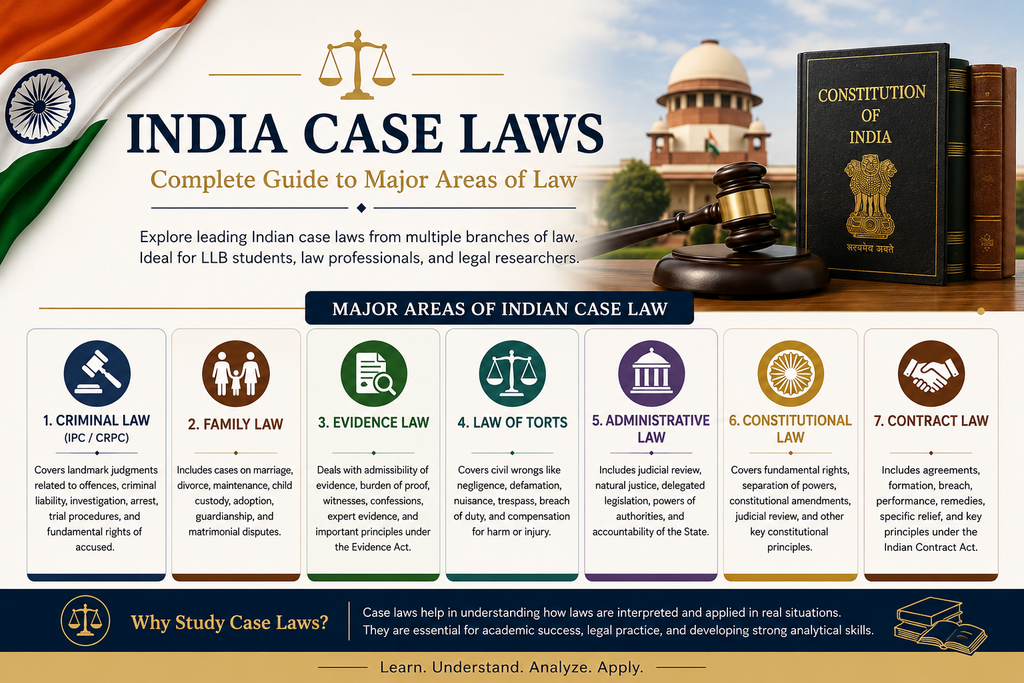
Indian case law plays an important role in explaining how courts interpret the Constitution of India, statutes, legal rights, duties, and principles of justice. Landmark judgments of the Supreme Court of India and various High Courts have significantly contributed to the development of Indian jurisprudence.
Our India Case Laws section covers important areas of law, including Criminal Law, Family Law, Evidence Law, Law of Torts, Administrative Law, Constitutional Law, and Contract Law.
Explore Indian Case Laws by Area of Law
1. Criminal Law (IPC / CrPC)
Explore important Indian criminal law judgments dealing with criminal offences, criminal liability, investigation, arrest, bail, trial procedures, evidence, sentencing, and fundamental rights of accused persons.
This section includes cases related to the Indian Penal Code (IPC) and Code of Criminal Procedure (CrPC), along with important developments in Indian criminal jurisprudence.
Explore: Criminal Offences • Bail • Arrest • Investigation • Trial • Criminal Liability • Sentencing
2. Family Law
Study important Indian family law cases concerning marriage, divorce, maintenance, adoption, custody, guardianship, succession, inheritance, and matrimonial disputes.
These judgments help students understand how Indian courts apply personal laws and statutory provisions in family-related disputes.
Explore: Marriage • Divorce • Maintenance • Adoption • Child Custody • Succession • Inheritance
3. Evidence Law
Explore landmark judgments concerning the admissibility, relevance, and evaluation of evidence in judicial proceedings.
This section covers important principles relating to burden of proof, documentary evidence, oral evidence, confessions, admissions, witnesses, expert evidence, and circumstantial evidence.
Explore: Evidence • Burden of Proof • Witnesses • Confessions • Admissions • Documentary Evidence
4. Law of Torts
Discover important Indian tort law cases involving negligence, nuisance, defamation, trespass, strict liability, vicarious liability, and compensation for injury or loss.
These cases demonstrate how courts determine legal responsibility when one person’s actions cause harm to another.
Explore: Negligence • Defamation • Nuisance • Trespass • Strict Liability • Compensation
5. Administrative Law
Explore leading Indian cases concerning administrative authorities, judicial review, natural justice, delegated legislation, administrative discretion, legitimate expectation, and procedural fairness.
These judgments are particularly important for understanding the relationship between government authorities and individuals.
Explore: Judicial Review • Natural Justice • Administrative Discretion • Delegated Legislation • Fair Hearing
6. Constitutional Law
Study some of the most important decisions in Indian constitutional law concerning Fundamental Rights, Directive Principles, separation of powers, judicial review, federalism, constitutional amendments, and the basic structure of the Constitution.
Landmark constitutional judgments have played a major role in defining the powers of the Parliament, Executive, and Judiciary and protecting constitutional rights.
Explore: Fundamental Rights • Judicial Review • Basic Structure • Federalism • Constitutional Amendments • Separation of Powers
7. Contract Law
Explore important Indian contract law cases dealing with formation of contracts, offer and acceptance, consideration, breach of contract, damages, performance, indemnity, guarantee, and contractual obligations.
These judgments help students understand how courts interpret and enforce contractual agreements under Indian law.
Explore: Offer & Acceptance • Consideration • Breach of Contract • Damages • Performance • Indemnity • Guarantee
Why Study Indian Case Laws?
Studying Indian Case Laws is essential for developing a practical understanding of how legal principles are interpreted and applied by Indian courts. Case laws provide students with real examples of legal disputes and demonstrate how judges apply legislation and constitutional principles to particular facts.
Our collection is especially useful for:
- LLB Students
- Law Graduates
- Legal Researchers
- Lawyers & Legal Professionals
- Students Preparing for Law Exams
- Academic Researchers
- Anyone Interested in Indian Law
Learn Law Through Landmark Judgments
Whether you are preparing for an LLB examination, writing a legal assignment, conducting research, preparing for a moot court, or simply improving your legal knowledge, our India Case Laws section can help you understand important legal principles through significant judicial decisions.
Explore cases by legal subject and learn about the facts of the case, legal issues, arguments, judgment, ratio decidendi, and significance of important decisions.
📚 Explore India Case Laws
Choose a category above and discover landmark Indian judgments that have shaped the development of Indian law.
Educational Disclaimer: The information provided on this page is intended for educational and research purposes only and should not be considered legal advice. Always refer to the official judgment and applicable legislation for authoritative legal information.