
Administrative law is one of the most important branches of public law that governs the activities, powers, duties, and procedures of administrative authorities and government agencies. In modern states, governments perform countless functions such as education, health care, taxation, transportation, social welfare, environmental protection, and public safety. Because of these expanding responsibilities, administrative agencies have become essential for implementing laws and managing public affairs. Administrative law ensures that these authorities operate fairly, legally, and within the limits of their powers.
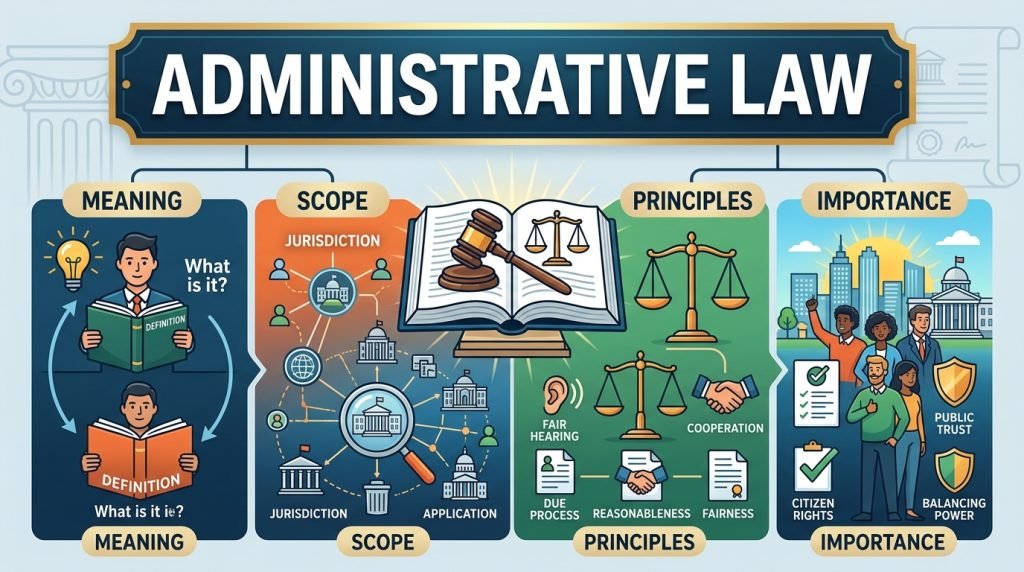
What is Administrative Law?
Administrative law refers to the body of legal rules and principles that regulate the administration and government agencies. It controls the exercise of powers by public authorities and ensures that administrative actions comply with the law.
Administrative law deals with:
- The powers of administrative authorities
- The procedures followed by government departments
- The rights and duties of citizens against administrative actions
- Judicial control over administrative decisions
Administrative law acts as a bridge between the government and the public. It protects citizens from the misuse of governmental powers while allowing the administration to perform its functions effectively.
Definition of Administrative Law
Different legal scholars have defined administrative law in various ways.
According to Ivor Jennings
Administrative law is the law relating to the administration. It determines the organization, powers, and duties of administrative authorities.
According to Dicey
Administrative law includes the principles that regulate the relation between citizens and the state officials.
According to Wade
Administrative law is the law that controls governmental power.
These definitions show that administrative law mainly focuses on controlling administrative authorities and protecting individual rights.
Historical Development of Administrative Law
Administrative law developed because governments began performing more functions after the industrial revolution and the rise of welfare states.
Early Period
In earlier times, governments had limited responsibilities. Most functions were confined to maintaining law and order, defense, and taxation. There was little need for administrative regulation.
Industrial Revolution
The Industrial Revolution increased economic and social complexities. Governments started regulating industries, labor conditions, trade, transportation, and public health.
Welfare State Era
In the twentieth century, states adopted welfare policies. Governments became responsible for education, housing, employment, healthcare, and social security. As administrative agencies expanded, administrative law became necessary to regulate their powers.
Modern Era
Today, administrative law is a major legal discipline in almost every country. It ensures transparency, accountability, and fairness in public administration.
Nature of Administrative Law
Administrative law has certain unique characteristics that distinguish it from other branches of law.
1. It is Public Law
Administrative law is part of public law because it governs the relationship between the state and citizens.
2. It Regulates Government Agencies
It mainly focuses on the organization and functioning of administrative authorities.
3. It Ensures Fairness
Administrative law ensures that public authorities act fairly and reasonably.
4. It Protects Individual Rights
Citizens can challenge unlawful administrative actions through courts and tribunals.
5. It is Dynamic
Administrative law changes according to social, economic, and political developments.
Scope of Administrative Law
The scope of administrative law is very wide because administrative agencies perform numerous functions in modern governments.
1. Rule-Making Powers
Administrative agencies create rules and regulations to implement laws passed by legislatures.
For example:
- Traffic regulations
- Environmental rules
- Tax procedures
2. Administrative Adjudication
Administrative bodies often decide disputes related to licenses, taxes, employment, immigration, and public services.
3. Administrative Procedures
Administrative law regulates procedures followed by authorities while making decisions.
4. Delegated Legislation
Legislatures delegate certain law-making powers to administrative authorities.
5. Judicial Review
Courts review administrative actions to ensure legality and constitutionality.
6. Public Accountability
Administrative law promotes transparency and accountability in governance.
Sources of Administrative Law
Administrative law comes from several sources.
1. Constitution
The constitution is the supreme source of administrative law. It defines governmental powers and fundamental rights.
2. Statutes
Parliament or legislatures enact laws that establish administrative agencies and define their powers.
3. Delegated Legislation
Rules, regulations, orders, and notifications issued by administrative authorities are important sources.
4. Judicial Decisions
Court judgments play a significant role in developing administrative law principles.
5. Customs and Conventions
Administrative practices and conventions may also influence administrative law.
Principles of Administrative Law
Administrative law is based on several important principles that guide public authorities.
1. Principle of Natural Justice
Natural justice ensures fairness in administrative decision-making.
Main Rules of Natural Justice
a) Rule Against Bias
No person should decide a case in which they have a personal interest.
b) Right to Fair Hearing
Every person has the right to present their case before a decision is made.
Example:
If a government employee is accused of misconduct, they must be given an opportunity to defend themselves.
2. Rule of Law
The rule of law means that all authorities must act according to law and not arbitrarily.
No official is above the law.
3. Doctrine of Ultra Vires
Ultra vires means “beyond powers.”
If an administrative authority acts beyond its legal powers, its action can be declared invalid by courts.
4. Reasonableness
Administrative decisions must be reasonable and rational.
Authorities cannot make decisions based on personal preferences or arbitrary considerations.
5. Transparency and Accountability
Government agencies must operate openly and remain accountable for their actions.
Delegated Legislation
Delegated legislation is one of the most important aspects of administrative law.
Meaning
Delegated legislation refers to rules and regulations made by administrative authorities under powers delegated by the legislature.
Reasons for Delegated Legislation
1. Increasing Government Functions
Modern governments perform many complex tasks.
2. Technical Expertise
Experts in specialized fields can create detailed regulations.
3. Flexibility
Administrative authorities can quickly amend rules according to changing needs.
4. Saving Legislative Time
Legislatures cannot handle every minor detail.
Advantages of Delegated Legislation
- Quick decision-making
- Expert involvement
- Flexibility
- Efficient administration
Disadvantages of Delegated Legislation
- Risk of misuse of power
- Reduced parliamentary control
- Threat to individual freedoms
Therefore, delegated legislation must be properly supervised.
Administrative Tribunals
Administrative tribunals are specialized bodies established to resolve disputes related to administration.
Examples
- Tax tribunals
- Labor tribunals
- Service tribunals
- Immigration tribunals
Features of Administrative Tribunals
- Specialized expertise
- Faster procedures
- Less formal than courts
- Cost-effective dispute resolution
Advantages of Administrative Tribunals
1. Speedy Justice
Cases are resolved more quickly than ordinary courts.
2. Expert Knowledge
Experts handle technical matters.
3. Affordable Process
Tribunals usually involve lower costs.
Disadvantages of Administrative Tribunals
- Limited independence
- Possibility of executive influence
- Lack of strict procedural safeguards
Judicial Control of Administrative Action
Courts play a vital role in controlling administrative authorities.
Meaning of Judicial Review
Judicial review is the power of courts to examine the legality of administrative actions.
If authorities exceed their powers or violate rights, courts may invalidate their actions.
Grounds for Judicial Review
1. Illegality
Authorities must act within legal powers.
2. Irrationality
Decisions should not be unreasonable.
3. Procedural Impropriety
Authorities must follow proper procedures.
4. Abuse of Power
Power should not be used for improper purposes.
Remedies Against Administrative Actions
Citizens can seek various remedies against unlawful administrative acts.
1. Writs
Higher courts issue writs to control administrative authorities.
Important Writs
Habeas Corpus
Protects personal liberty.
Mandamus
Orders public authorities to perform duties.
Certiorari
Quashes unlawful decisions.
Prohibition
Stops authorities from exceeding powers.
Quo Warranto
Challenges unlawful occupation of public office.
2. Injunction
Courts may restrain authorities from unlawful acts.
3. Damages
Compensation may be awarded for wrongful administrative actions.
Relationship Between Administrative Law and Constitutional Law
Administrative law and constitutional law are closely related.
Constitutional Law
- Defines structure of government
- Establishes fundamental rights
- Distributes governmental powers
Administrative Law
- Regulates day-to-day functioning of administration
- Controls government agencies
- Ensures lawful exercise of powers
Constitutional law provides the framework, while administrative law deals with practical administration.
Importance of Administrative Law
Administrative law is extremely important in modern society.
1. Controls Government Powers
It prevents abuse of authority.
2. Protects Citizens’ Rights
Citizens can challenge unlawful actions.
3. Promotes Fairness
Administrative authorities must follow fair procedures.
4. Ensures Efficient Administration
Administrative law helps government agencies function effectively.
5. Encourages Accountability
Public officials remain answerable for their actions.
6. Supports Democracy
Administrative law strengthens democratic governance by limiting arbitrary power.
Administrative Law in Modern Welfare States
Modern welfare states provide various public services and social benefits.
Governments regulate:
- Education
- Healthcare
- Housing
- Employment
- Environment
- Transportation
- Consumer protection
Administrative agencies are essential for managing these functions. Administrative law ensures that these agencies work within legal boundaries.
Challenges in Administrative Law
Despite its importance, administrative law faces several challenges.
1. Excessive Delegation
Legislatures sometimes delegate too much power to administrative authorities.
2. Bureaucratic Delay
Administrative procedures may become slow and inefficient.
3. Corruption
Misuse of administrative powers can lead to corruption.
4. Lack of Transparency
Some agencies operate without sufficient public accountability.
5. Political Influence
Administrative decisions may be affected by political pressure.
Administrative Law in Pakistan
In Pakistan, administrative law plays a vital role in regulating governmental authorities.
The Constitution of Pakistan provides:
- Fundamental rights
- Judicial review
- Constitutional remedies
Higher courts supervise administrative actions to ensure legality and fairness.
Administrative tribunals in Pakistan include:
- Service tribunals
- Tax tribunals
- Banking courts
- Accountability courts
The judiciary frequently uses constitutional writs to protect citizens from unlawful administrative actions.
Difference Between Administrative Law and Ordinary Law
| Administrative Law | Ordinary Law |
| Deals with administrative authorities | Deals with general legal matters |
| Focuses on public administration | Covers private and criminal disputes |
| Regulates governmental actions | Regulates relations between individuals |
| Includes delegated legislation | Mainly based on statutes and precedents |
Future of Administrative Law
Administrative law will continue growing because governments are becoming more involved in social and economic activities.
Future developments may include:
- Digital governance
- Artificial intelligence in administration
- Greater transparency through technology
- Stronger protection of human rights
- Online administrative procedures
As technology evolves, administrative law must adapt to new challenges while maintaining fairness and accountability.