
Introduction
The UK vs USA legal system comparison is one of the most interesting topics for law students because both countries share a strong historical connection to the common law tradition, yet their modern legal systems operate in significantly different ways. Students who study comparative law often notice that the United States inherited many legal ideas from England, but developed a constitutional and federal structure that makes the American system very different from the legal system of the United Kingdom.
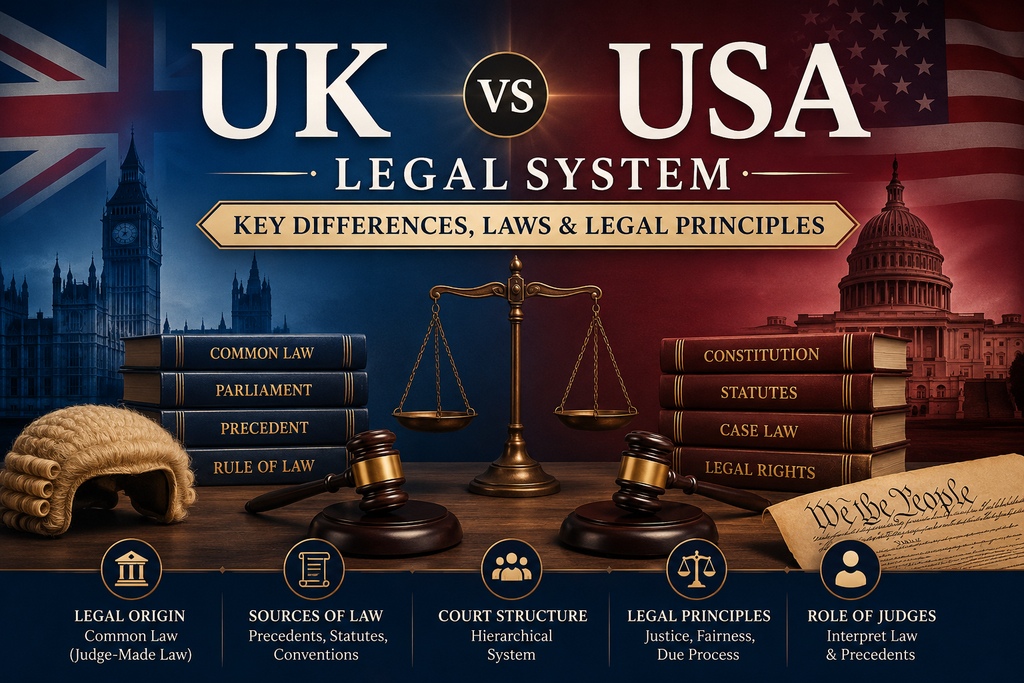
At first glance, the UK vs USA legal system may appear similar because both countries use common-law principles, judicial precedent, adversarial court procedures, and independent judges. However, important differences exist in constitutional structure, legislative power, judicial review, federalism, court organization, legal terminology, judicial appointments, and the relationship between courts and legislatures.
1. Historical Background of the UK and USA Legal Systems
The legal system of England developed over centuries through the decisions of judges, customs, legislation, and constitutional practices. English common law became an important source of legal principles and eventually influenced many countries around the world.
The United States was originally composed of British colonies. Before independence, colonial legal systems were heavily influenced by English law. After the American Revolution, however, the United States created its own constitutional framework.
The U.S. Constitution became the supreme law of the United States and established a federal government divided into legislative, executive, and judicial branches. The U.S. federal judiciary operates under Article III of the Constitution.
This historical development explains why the UK vs USA legal system has both similarities and fundamental differences.
The United Kingdom continued developing its constitutional system through statutes, judicial decisions, conventions, historical documents, and parliamentary practice. The United States, in contrast, adopted a written Constitution that defines governmental powers and provides a framework against which laws can be tested.
2. Common Law: The Major Similarity
One of the strongest similarities in the UK vs USA legal system is the influence of common law.
Common law originated in England and developed through judicial decisions. Courts gradually established legal principles by deciding disputes, and later courts relied upon those earlier decisions.
The U.S. Courts explain that common law originated in England and remains in use in the United States, where legal principles have developed through a historical succession of judicial decisions.
Judicial precedent remains important in both jurisdictions.
For example, if a higher court establishes an important legal principle, lower courts generally follow that principle when deciding similar cases, subject to the rules of the particular jurisdiction.
However, common law does not mean that the UK and USA have identical legal systems.
The American system developed its own constitutional principles, federal structure, state laws, and judicial doctrines. Consequently, common-law reasoning operates within different constitutional environments.
3. Written Constitution vs Uncodified Constitution
This is one of the most important differences in the UK vs USA legal system.
United States
The United States has a written Constitution.
The Constitution is considered the supreme law of the United States. Government institutions must operate within constitutional limits.
The U.S. Constitution establishes the federal government and divides governmental power between the legislative, executive, and judicial branches.
The Constitution also contains important protections for individual rights, including provisions found in the Bill of Rights and later constitutional amendments.
United Kingdom
The United Kingdom does not have a single written constitutional document equivalent to the U.S. Constitution.
Instead, the UK constitutional system is based on multiple sources, including legislation, judicial decisions, constitutional conventions, historical documents, and other constitutional principles.
One of the central principles is parliamentary sovereignty.
The traditional doctrine of parliamentary sovereignty means that Parliament has supreme legislative authority. Government sources describe Parliament as the supreme legislative body and explain that, unlike countries with rigid written constitutions, the UK does not generally give courts power to invalidate primary legislation simply because they consider it unconstitutional.
Therefore, the constitutional foundations are a major point of difference in the UK vs USA legal system.
4. Parliamentary Sovereignty vs Constitutional Supremacy
The principle of parliamentary sovereignty is central to understanding the UK.
In simple terms, Parliament makes legislation, and courts interpret and apply legislation. UK courts generally cannot strike down an Act of Parliament merely because they believe it conflicts with constitutional principles.
This is very different from the United States.
In the United States, the Constitution is supreme. Courts can determine whether legislation is consistent with the Constitution. The federal courts have the authority to determine constitutional questions and can invalidate laws that conflict with constitutional requirements.
This distinction makes the UK vs USA legal system especially important in constitutional law.
Simple example
Imagine Parliament in the UK passes a controversial statute.
A UK court normally applies and interprets the statute rather than declaring the Act invalid simply because it violates an unwritten constitutional principle.
Now imagine Congress passes a federal law in the United States that conflicts with the U.S. Constitution.
A court may consider the constitutional question and determine that the legislation cannot be enforced to the extent that it conflicts with the Constitution.
This difference demonstrates the fundamentally different constitutional relationships between legislatures and courts.
5. Federal System in the USA vs Devolved System in the UK
Another major distinction in the UK vs USA legal system concerns the distribution of governmental power.
The United States is a federal country.
There are two major levels of government:
- Federal government
- State governments
Each state has its own legal system, courts, statutes, and constitution, while the federal government has authority over matters assigned to it by the Constitution.
The U.S. Courts explain that federalism means power is shared between the federal government and state governments, with separate federal and state court systems.
The UK has a different structure.
The United Kingdom consists of England and Wales, Scotland, and Northern Ireland, each with important differences in legal institutions and, particularly, Scotland’s distinct legal tradition.
Devolution has also given legislative and governmental powers to institutions in Scotland, Wales, and Northern Ireland.
Therefore, it would be inaccurate to treat “UK law” as completely identical throughout the United Kingdom.
6. Court Structure in the United States
The American court system has federal and state components.
The federal system includes:
- U.S. Supreme Court
- U.S. Courts of Appeals
- U.S. District Courts
- Specialized federal courts
The federal judiciary currently includes 13 Courts of Appeals and 94 District Courts, among other federal courts.
State courts operate separately and generally deal with a very large proportion of ordinary criminal and civil cases.
State court systems differ from state to state.
For example, one state may call its trial court a Superior Court, while another may use a different name. State courts may also have different rules concerning appeals, judges, procedures, and jurisdiction.
This makes the UK vs USA legal system comparison more complicated because the USA does not have a single unified court system for all legal disputes.
7. Court Structure in the United Kingdom
The UK court structure is also complex because different jurisdictions have their own legal institutions.
The UK Supreme Court is the final court of appeal for civil cases across the United Kingdom and for criminal cases from England, Wales, and Northern Ireland. It hears cases involving important points of law and matters of significant public or constitutional importance.
In England and Wales, the court hierarchy includes trial courts and appellate courts, including the High Court, Crown Court, Court of Appeal, and Supreme Court.
Scotland has its own legal system and courts, including the Court of Session and High Court of Justiciary.
Northern Ireland also has its own court structure.
Consequently, when studying the UK vs USA legal system, students should remember that “UK law” encompasses multiple legal jurisdictions rather than one completely uniform system.
8. Supreme Court: UK vs USA
The Supreme Courts of the two countries have different constitutional roles.
UK Supreme Court
The UK Supreme Court is primarily an appellate court.
It considers appeals from lower courts and focuses on significant legal questions. According to the Court itself, it is the final court of appeal for UK civil cases and for criminal cases from England, Wales, and Northern Ireland.
It also plays an important role in developing UK common law.
U.S. Supreme Court
The U.S. Supreme Court is the highest federal court and has an important constitutional role.
It can decide whether laws or governmental actions are compatible with the U.S. Constitution. The U.S. Courts describe judicial review as an important function of the Supreme Court in ensuring that governmental branches remain within constitutional limits.
Thus, although both countries have a “Supreme Court,” the constitutional significance of the two courts is not identical.
9. Judicial Review
Judicial review is another major difference in the UK vs USA legal system.
In the United States, judicial review allows courts to assess governmental action against the Constitution.
The federal judiciary can determine whether federal and state laws comply with constitutional requirements.
In the UK, judicial review primarily concerns the lawfulness of actions and decisions of public authorities. It is not generally equivalent to an American court striking down an Act of Parliament as unconstitutional.
The UK courts can examine whether public bodies have acted within their legal powers and according to applicable legal principles.
This distinction is essential for law students because “judicial review” does not mean exactly the same thing in both systems.
10. Role of Judges
Judges are important in both jurisdictions, but their constitutional environments differ.
In the United States, federal judges are nominated by the President and confirmed by the Senate. Federal judges generally hold office during good behavior, which traditionally means they have tenure for life unless they leave office voluntarily or are removed through the constitutional impeachment process.
The UK has a different judicial appointment system.
Judicial appointments are made through a structured process involving the Judicial Appointments Commission for many senior judicial appointments in England and Wales and the relevant constitutional arrangements for other UK jurisdictions.
The difference in appointment systems reflects the different constitutional structures of the two countries.
11. Federal Law vs State Law in America
One of the most important concepts in the UK vs USA legal system comparison is the distinction between federal and state law.
In the United States, a legal question may depend upon:
- Federal constitutional law
- Federal statutes
- Federal regulations
- State constitutions
- State statutes
- State regulations
- State common law
- Local laws and ordinances
This can make American law highly complex.
For example, a contract dispute may primarily involve state law, while a case involving a federal constitutional issue may fall within federal jurisdiction.
The U.S. Courts explain that state courts generally handle many ordinary criminal and civil matters, while federal courts hear cases involving federal laws, constitutional questions, certain disputes involving states, bankruptcy, and other matters within federal jurisdiction.
The UK does not operate under the same federal-state division.
12. Jury System
Juries are another interesting area of comparison.
Both the UK and USA use juries, particularly in criminal proceedings, although the rules and practical use of juries differ.
In the United States, juries can play a major role in both criminal and civil litigation.
American criminal defendants have important constitutional protections relating to jury trials.
In England and Wales, juries are particularly associated with serious criminal trials in the Crown Court.
However, not every legal dispute in either country is decided by a jury.
Many cases are determined entirely by judges, particularly appellate cases and many civil or procedural matters.
13. Lawyers and Legal Professions
The legal professions also differ.
In England and Wales, the traditional legal professions include:
- Solicitors
- Barristers
- Judges
Solicitors generally provide legal advice and manage many aspects of client matters, while barristers traditionally specialize in advocacy and legal opinions.
The distinction has evolved over time, and the roles can overlap in certain circumstances.
In the United States, lawyers are generally referred to as attorneys or lawyers rather than being divided into solicitor and barrister professions in the same traditional manner.
American lawyers must generally be admitted to practice in a particular state or jurisdiction, subject to that jurisdiction’s requirements.
This is an important practical difference in the UK vs USA legal system.
14. Criminal Law: UK vs USA
Criminal law differs significantly between the two jurisdictions.
In the United States, criminal offences may be created under both federal and state law. Most ordinary criminal prosecutions take place under state law, while federal prosecutors handle offences falling within federal jurisdiction.
The U.S. Constitution provides significant protections to criminal defendants, including due process rights and protections relating to searches, self-incrimination, counsel, and fair trial procedures.
In the UK, criminal law is governed by legislation and common-law principles, depending on the offence and jurisdiction.
England and Wales have their own criminal law framework, while Scotland has a distinct criminal law system.
Therefore, the phrase UK vs USA legal system should not lead students to assume that criminal law operates identically across either country.
15. Civil Law and Compensation
Civil litigation is another area where similarities and differences can be observed.
Both countries recognize areas such as:
- Contract law
- Tort law
- Property law
- Commercial law
- Family law
- Employment law
However, rules can vary significantly.
The United States has a strong class-action litigation culture in certain areas. Damages, litigation procedures, discovery, contingency fees, and jury involvement can also make American civil litigation look different from litigation in England and Wales.
The UK has its own procedural rules and approaches to costs and litigation.
Therefore, students studying comparative law should examine the actual jurisdiction and area of law rather than relying on general assumptions.
16. Discovery in American Litigation
One particularly notable feature of the UK vs USA legal system is the role of discovery, more commonly described in modern U.S. federal procedure as “discovery.”
American litigation can involve extensive pre-trial exchange of information, documents, electronically stored information, depositions, interrogatories, and requests for admission.
This process can be extremely important in complex commercial litigation.
England and Wales also have disclosure obligations, but the terminology, scope, procedures, and strategic approach differ.
The American system can therefore feel more extensive and document-intensive to someone familiar primarily with traditional English litigation.
17. Precedent and Stare Decisis
Both legal systems place substantial importance on precedent.
The doctrine of stare decisis encourages courts to follow established legal principles from previous decisions.
However, the operation of precedent differs because the constitutional structures and court hierarchies differ.
In the United States, decisions of the U.S. Supreme Court are binding on lower federal courts regarding federal constitutional and federal legal questions within the relevant scope. State supreme courts are generally authoritative on questions of state law.
In the UK, decisions of higher courts also have significant precedential authority, although the precise rules differ between jurisdictions and courts.
This is one of the strongest common features of the UK vs USA legal system, but it should not be mistaken for complete uniformity.
18. Checks and Balances
The United States Constitution deliberately separates government into three branches:
- Legislative
- Executive
- Judicial
These branches operate through a system of checks and balances.
Congress makes federal legislation, the President and executive agencies administer and enforce laws, and courts interpret and apply the law.
The judiciary can also consider constitutional challenges to government action.
The UK has a different constitutional arrangement.
The UK also has institutional separation and judicial independence, but it does not follow the American model of strict constitutional separation in exactly the same way.
The relationship between Parliament, government, and courts is shaped by parliamentary sovereignty, constitutional conventions, statutes, and judicial principles.
19. Key Differences: UK vs USA Legal System
The following comparison provides a simple overview:
| Feature | United Kingdom | United States |
| Constitutional structure | Uncodified constitution | Written Constitution |
| Government structure | Unitary state with devolution | Federal system |
| Supreme constitutional principle | Parliamentary sovereignty | Constitutional supremacy |
| Highest court | UK Supreme Court | U.S. Supreme Court |
| Federal courts | No equivalent federal-state court division | Federal and state courts |
| Judicial review | Primarily review of public authority action | Strong constitutional judicial review |
| Common law | Major source of law | Major historical influence |
| Legislature | UK Parliament | Congress and state legislatures |
| Legal professions | Solicitors and barristers traditionally | Attorneys/lawyers |
| State law | Different UK jurisdictions | Each state has its own laws |
| Federal law | Not applicable in the U.S. sense | Major source of law |
| Judicial appointments | Different UK appointment mechanisms | Presidential nomination and Senate confirmation for federal judges |
20. Similarities Between the UK and USA Legal Systems
Despite their differences, the two systems share many important characteristics.
1. Common-law heritage
Both systems were heavily influenced by English common law.
2. Judicial precedent
Previous judicial decisions remain important sources of legal reasoning.
3. Independent judiciary
Judicial independence is a fundamental principle in both systems.
4. Adversarial proceedings
Both jurisdictions generally use adversarial methods in litigation, where opposing parties present their arguments and evidence before an impartial decision-maker.
5. Professional lawyers
Both systems have highly developed legal professions.
6. Appellate courts
Both systems allow parties, subject to procedural and jurisdictional requirements, to appeal certain decisions to higher courts.
7. Rule of law
Both legal systems emphasize the rule of law and the importance of lawful government.
The U.S. Courts describe the rule of law as requiring laws to be publicly promulgated, equally enforced, independently adjudicated, and consistent with fundamental principles.
Conclusion
The UK vs USA legal system comparison reveals two legal traditions that share a common historical foundation but have developed into substantially different constitutional and judicial systems.
The United Kingdom is strongly associated with common law, parliamentary sovereignty, an uncodified constitutional framework, and multiple legal jurisdictions within the Union. Its courts play an important role in interpreting legislation, developing common law, and reviewing the legality of governmental action.
The United States, meanwhile, operates under a written Constitution that is regarded as the supreme law of the land. Its federal structure divides authority between the federal government and the states, while its judiciary has a significant role in constitutional interpretation and judicial review.
The biggest lesson from the UK vs USA legal system is that historical similarity does not mean constitutional identity. Both countries inherited important common-law traditions, but their legal institutions developed according to different political, constitutional, and historical conditions.
For LLB students, understanding the UK vs USA legal system can provide a strong foundation for comparative constitutional law, jurisprudence, international law, and legal research. By studying both systems side by side, students can better understand the relationship between courts, legislatures, constitutions, judges, precedent, and individual rights.
Ultimately, the UK vs USA legal system is not simply a comparison between two sets of courts. It is a comparison between two different approaches to constitutional government, legal authority, judicial power, and the rule of law.