
For more than two decades, John Roberts has stood at the center of America’s most important constitutional battles.
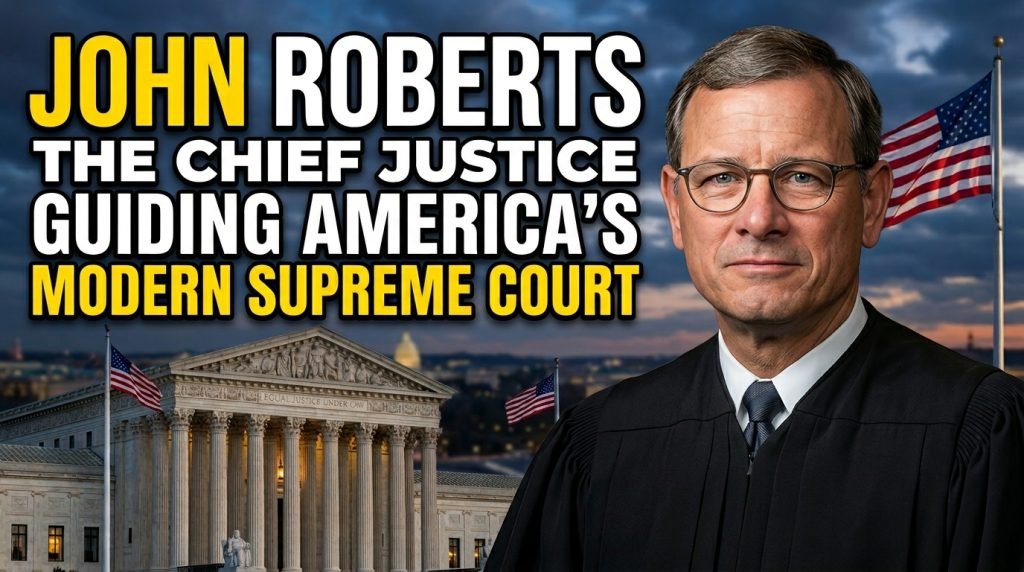
As Chief Justice of the United States since 2005, Roberts has overseen a Supreme Court deeply involved in issues such as:
- Health care
- Voting rights
- Gun laws
- Abortion
- Presidential power
Careful, disciplined, and highly strategic, Roberts is known for defending the Court’s institutional credibility while often steering it in a conservative direction.
His leadership has become so influential that modern legal scholars frequently refer to the current era simply as:
“The Roberts Court”
John Roberts
- Full Name: John Glover Roberts Jr.
- Born: January 27, 1955, Buffalo, New York
- Position: 17th Chief Justice of the United States
- Serving Since: 2005
- Nominated By: George W. Bush
- Education: Harvard University
- Spouse: Jane Sullivan Roberts
- Children: 2
A Brilliant Student with Competitive Drive
Although born in Buffalo, New York, Roberts grew up mainly in Indiana after his family relocated there.
He attended:
La Lumiere School
where he excelled both academically and athletically.
Roberts later entered:
Harvard University
earning:
- A.B. degree in 1976
- J.D. degree in 1979
At Harvard Law School, he became managing editor of the prestigious:
Harvard Law Review
His extraordinary legal talent quickly became obvious.
Learning from Legal Legends
After law school, Roberts clerked for two highly respected legal figures:
- Judge Henry Friendly
- Future Chief Justice William Rehnquist
These experiences deeply influenced Roberts’ judicial philosophy:
- Respect for legal institutions
- Careful interpretation of law
- Preference for judicial restraint
Rising Through Government and Private Practice
Roberts built an impressive legal career in both government and private law.
He served in the administrations of:
- Ronald Reagan
- George H. W. Bush
including work as:
Principal Deputy Solicitor General
In private practice at:
- Hogan & Hartson
he argued:
39 cases before the U.S. Supreme Court
earning a reputation as one of America’s elite appellate lawyers.
Becoming Chief Justice
In 2003, President George W. Bush appointed Roberts to the U.S. Court of Appeals for the D.C. Circuit.
Just two years later, Bush nominated him as:
Chief Justice of the United States
The Senate confirmed him in September 2005.
At only 50 years old, Roberts became one of the youngest Chief Justices in modern history.
The Roberts Court
Under Roberts’ leadership, the Supreme Court has shifted steadily toward conservatism.
Yet Roberts often tries to present the Court as:
- Independent
- Nonpartisan
- Institutionally stable
He has repeatedly argued that judges are:
Not politicians in robes.
Landmark Supreme Court Decisions
One of Roberts’ most surprising and important decisions came in:
National Federation of Independent Business v. Sebelius
This case challenged:
Affordable Care Act
Many expected Roberts to strike down the law.
Instead, he cast the decisive vote to uphold most of the Affordable Care Act, including its individual mandate under Congress’s taxing power.
The decision shocked many conservatives and cemented Roberts’ reputation as an institutionalist.
Voting Rights Controversy
In another major case:
Shelby County v. Holder
Roberts wrote the majority opinion invalidating a key section of the:
Voting Rights Act of 1965
Supporters argued the ruling modernized outdated federal oversight.
Critics claimed it weakened protections against racial discrimination in voting.
The case remains highly controversial.
Leading During Political Turmoil
Roberts has also played major institutional roles during politically tense moments.
He:
- Presided over President Donald Trump’s first impeachment trial
- Administered the presidential oath to multiple U.S. presidents
- Publicly defended judicial independence from partisan attacks
At times, Roberts has issued rare public statements warning against viewing judges as purely political actors.
Balancing Conservatism and Institutional Stability
Although generally conservative, Roberts occasionally joins liberal justices in closely divided cases.
His decisions often reflect two competing goals:
- Advancing conservative legal principles
- Protecting the Supreme Court’s public legitimacy
This balancing act has made him one of the most closely watched judges in modern America.
A Defining Judicial Figure
Today, the “Roberts Court” continues reshaping American constitutional law on issues including:
- Abortion
- Gun rights
- Religious liberty
- Administrative power
- Election law
Whether praised or criticized, Roberts’ influence on modern American law is enormous.
Final Thoughts
John Roberts is more than a Chief Justice.
He is:
- A constitutional strategist
- A guardian of judicial institutions
- A central figure in modern American legal history
Through careful leadership and landmark rulings, he has helped define the direction of the U.S. Supreme Court in the 21st century.
And as debates over law, politics, and constitutional rights continue, the impact of the Roberts Court will likely shape America for decades to come.
Leave a Reply