
Before Sandra Day O’Connor, no woman had ever served on the United States Supreme Court.
That changed in 1981.
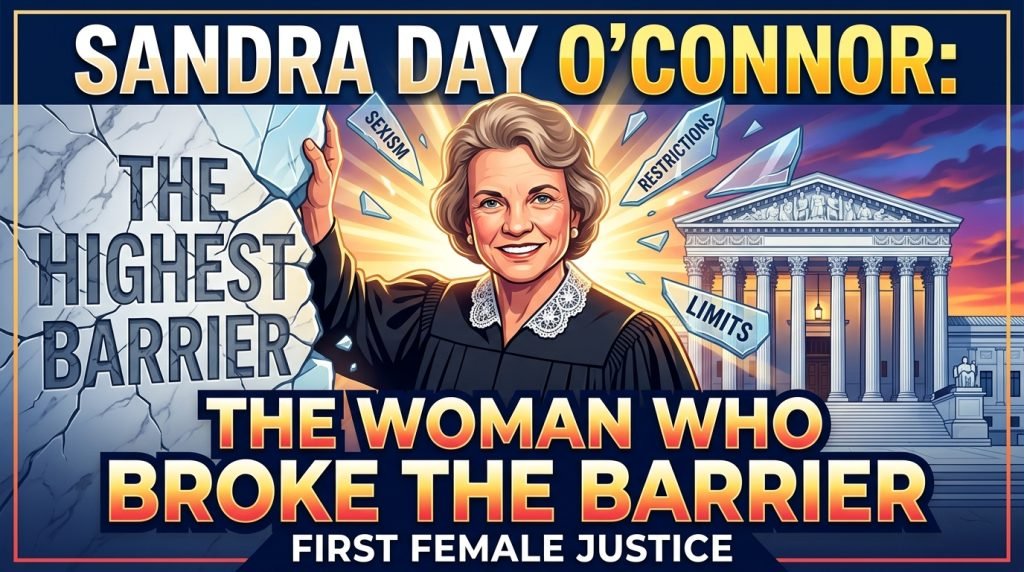
Pragmatic, independent, and often politically unpredictable, O’Connor became one of the most influential justices in modern American history. For nearly 25 years, she stood at the center of the Court, frequently casting the deciding vote in some of the nation’s most controversial cases.
But beyond the courtroom, her journey symbolized a historic breakthrough for women in American law and politics.
Sandra Day O’Connor
- Born: March 26, 1930, El Paso, Texas
- Died: December 1, 2023, Phoenix, Arizona
- Supreme Court Tenure: 1981–2006
- Appointed By: Ronald Reagan
- Education: Stanford University
- Major Honor: Presidential Medal of Freedom (2009)
Growing Up on the Arizona Frontier
Sandra Day O’Connor spent much of her childhood on the:
Lazy B Ranch
in southeastern Arizona.
Life on the ranch was demanding and physically tough. From an early age, she learned:
- Self-discipline
- Independence
- Hard work
Those qualities would later define her judicial style.
She later attended Stanford University, graduating near the top of her law school class in 1952.
One of her classmates was future Supreme Court Chief Justice:
William Rehnquist
Facing Discrimination as a Woman Lawyer
Despite graduating with excellent academic results, O’Connor struggled to find legal work.
Many law firms simply refused to hire women attorneys in the 1950s.
Unable to access the opportunities given to male classmates, she began working as a deputy county attorney in California for very little pay.
Instead of giving up, she steadily built her career through public service.
Rising Through Arizona Politics
O’Connor eventually moved into Arizona politics and law.
Her achievements included:
- Assistant Attorney General of Arizona
- Arizona State Senator
- The first female majority leader of any U.S. state senate
She later served as a judge in Arizona’s courts, gaining a reputation for fairness and practical decision-making.
By the late 1970s, she had become one of the country’s most respected female jurists.
The First Woman on the Supreme Court
In 1981, President Ronald Reagan fulfilled a campaign promise by nominating Sandra Day O’Connor to the Supreme Court.
The Senate confirmed her overwhelmingly.
Her appointment was historic:
She became the first woman ever to serve on the U.S. Supreme Court.
Millions of women and girls across America suddenly saw a barrier shattered.
The Court’s Most Powerful Swing Vote
Unlike justices who consistently leaned strongly left or right, O’Connor became known for her moderate and pragmatic approach.
She often preferred:
- Narrow rulings
- Practical compromise
- Incremental legal change
Because the Court was frequently divided, O’Connor became the decisive “swing vote” in many major cases.
Landmark Decisions
One of her most important rulings came in:
Planned Parenthood v. Casey
O’Connor helped preserve the core protections established in:
Roe v. Wade
while also introducing the:
“Undue burden” standard
which allowed some abortion restrictions but prevented laws that placed excessive obstacles on women seeking abortions.
The decision became one of the most influential abortion rulings in American legal history.
Bush v. Gore and National Controversy
O’Connor also joined the majority in:
Bush v. Gore
The ruling effectively resolved the disputed 2000 presidential election between:
- George W. Bush
- Al Gore
The case remains one of the most debated Supreme Court decisions in modern history.
Views on Race and Equality
O’Connor handled issues involving race and equality with careful balance.
In cases like:
- Shaw v. Reno
- Grutter v. Bollinger
she tried to balance:
- Equal opportunity
- Constitutional fairness
- Limits on government power
Her opinions often reflected complexity rather than strict ideology.
Retirement and Civic Education
In 2006, O’Connor retired from the Court to care for her husband:
John Jay O’Connor III
After leaving the Court, she remained deeply involved in civic education.
In 2009, she founded:
iCivics
to help students better understand democracy and government.
That same year, she received the:
Presidential Medal of Freedom
America’s highest civilian honor.
A Historic Legacy
Sandra Day O’Connor’s impact went far beyond legal decisions.
She changed:
- The role of women in the judiciary
- Public expectations about leadership
- The image of the Supreme Court itself
Her success opened doors for future female justices and inspired generations of women to pursue careers in law, politics, and public service.
Final Thoughts
Sandra Day O’Connor was more than a Supreme Court justice.
She was:
- A pioneer
- A pragmatist
- A trailblazer for women in America
By breaking barriers and shaping landmark decisions, she left a permanent mark on American law and society.
And even decades later, her legacy continues to influence both the Supreme Court and the broader fight for equality and representation.
Leave a Reply