
Thurgood Marshall – The First African American Supreme Court Justice
Few figures in American history fought harder for justice and equality than Thurgood Marshall.
Before becoming the first African American justice on the U.S. Supreme Court, Marshall spent decades battling racial segregation in courtrooms across America. His legal victories helped destroy the foundation of legalized racism and transformed the meaning of constitutional equality.
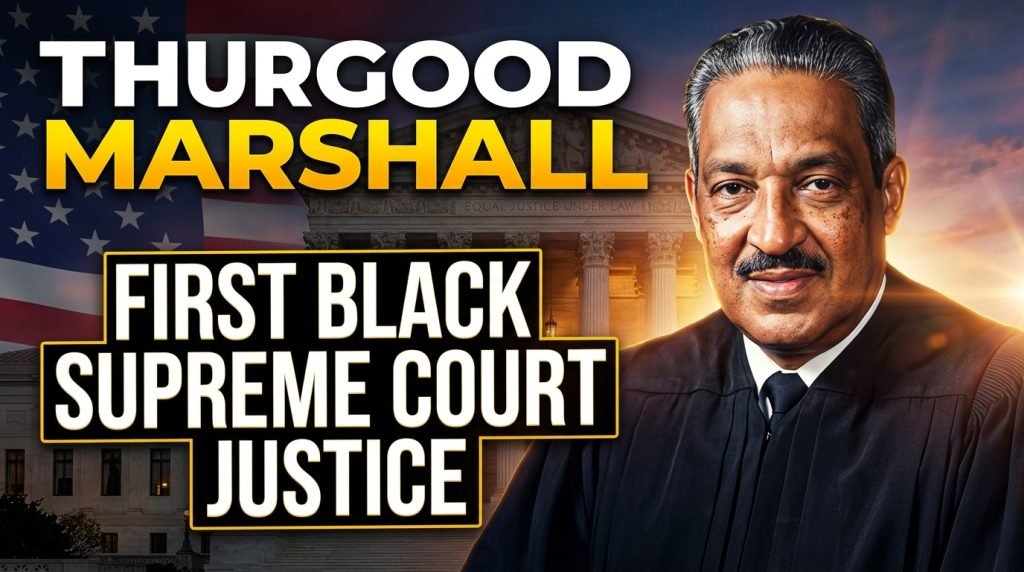
For millions of Americans, Thurgood Marshall became more than a lawyer —
he became a symbol of courage, justice, and civil rights.
Thurgood Marshall
- Born: July 2, 1908, Baltimore, Maryland
- Died: January 24, 1993, Bethesda, Maryland
- Supreme Court Tenure: 1967–1991
- Appointed By: Lyndon B. Johnson
- Most Famous Case: Brown v. Board of Education
- Buried At: Arlington National Cemetery
Growing Up in Segregated America
Thurgood Marshall was born in Baltimore, Maryland, during a time when racial segregation dominated American society.
Even as a brilliant student, Marshall experienced discrimination firsthand.
One painful example changed his life forever:
- He was denied admission to the University of Maryland Law School simply because he was Black.
Instead, he attended:
Howard University School of Law
There, he studied under legendary civil rights lawyer:
Charles Hamilton Houston
Houston taught Marshall that:
The law could become a weapon against injustice.
Marshall graduated first in his class in 1933.
Fighting Segregation Through the Courts
In 1936, Marshall joined the:
National Association for the Advancement of Colored People (NAACP)
He later helped create the:
NAACP Legal Defense and Educational Fund
As a lawyer, Marshall traveled across America defending Black citizens facing discrimination and violence.
He argued:
- 32 cases before the U.S. Supreme Court
- And won an astonishing 29 of them
Landmark Victories Before Brown v. Board
Before his most famous case, Marshall achieved several major victories, including:
- Smith v. Allwright
- Shelley v. Kraemer
- Sweatt v. Painter
Each case weakened racial segregation step by step.
Marshall carefully built a legal strategy aimed at destroying the entire system of “separate but equal.”
The Case That Changed America
Everything led to one historic battle:
Brown v. Board of Education
At the time, segregation in public schools was legal under the earlier ruling:
Plessy v. Ferguson
Marshall argued that:
- Segregated schools were inherently unequal,
- and violated the Constitution’s Equal Protection Clause.
The Supreme Court unanimously agreed.
The decision ended legal segregation in American public schools and became one of the greatest civil rights victories in history.
Becoming the First Black Supreme Court Justice
In 1967, President Lyndon B. Johnson appointed Marshall to the U.S. Supreme Court.
Johnson reportedly said:
“It was the right thing to do.”
Marshall became:
The first African American justice in Supreme Court history.
It was a historic milestone for the nation.
A Voice for Equality on the Court
During nearly 24 years on the Supreme Court, Marshall strongly defended:
- Civil rights
- Voting rights
- Gender equality
- Individual freedoms
He also became a fierce opponent of:
- The death penalty
- Government discrimination
- Abuse of constitutional rights
As the Court became more conservative over time, Marshall often found himself in dissent.
Because of his passionate opposition to decisions he viewed as unjust, he earned the nickname:
“The Great Dissenter”
A Lasting Legacy
Marshall’s impact extended far beyond the courtroom.
His work inspired generations of lawyers, activists, and judges fighting for justice.
Today, his name lives on through institutions such as:
- Thurgood Marshall College Fund
- Thurgood Marshall School of Law
His legal victories helped establish the modern framework for civil rights litigation in the United States.
Final Thoughts
Thurgood Marshall was more than a Supreme Court justice.
He was:
- A civil rights warrior
- A constitutional pioneer
- A defender of equality
Through courage, intelligence, and relentless determination, he helped America move closer to its promise of equal justice under law.
His legacy continues to inspire people around the world who believe the law can be used not just to enforce power —
but to fight injustice itself.
Leave a Reply