
Antonin Scalia: The Supreme Court Justice Who Redefined Conservative Constitutional Law
Few modern judges influenced American legal thinking as deeply as Antonin Scalia.
Brilliant, outspoken, and often controversial, Scalia became the intellectual leader of conservative jurisprudence in the United States. His powerful writing style, sharp humor, and uncompromising legal philosophy transformed debates about how the Constitution should be interpreted.
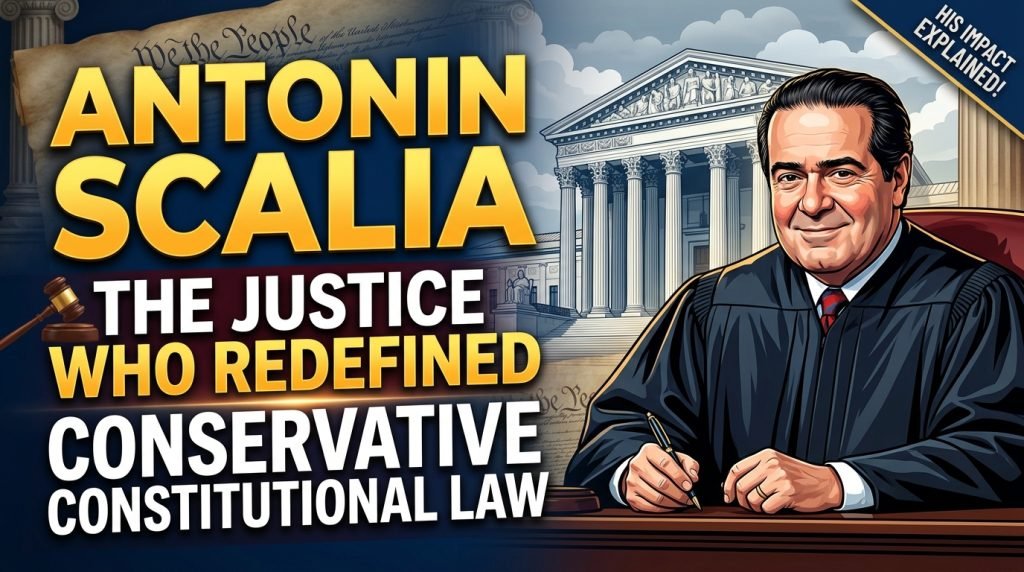
Whether admired or criticized, Scalia changed American law in ways that continue to shape courtrooms today.
Antonin Scalia
- Born: March 11, 1936, Trenton, New Jersey
- Died: February 13, 2016, Shafter, Texas
- Position: Associate Justice of the U.S. Supreme Court
- Served: 1986–2016
- Appointed By: Ronald Reagan
- Education:
- Georgetown University
- Harvard Law School
- Posthumous Honor: Presidential Medal of Freedom (2018)
A Brilliant Student with Strong Values
Antonin Scalia was born into an Italian American Catholic family in New Jersey.
His father was a professor of Romance languages, while his mother worked as a schoolteacher. Education and discipline were central parts of his upbringing.
Scalia quickly proved himself academically exceptional:
- Graduating as valedictorian from Georgetown University
- Earning honors from Harvard Law School
In 1960, he married Maureen McCarthy Scalia, and together they raised nine children.
Before the Supreme Court
Before becoming a justice, Scalia built an impressive legal and academic career.
He:
- Practiced law in Cleveland
- Taught law at the University of Virginia and University of Chicago
- Served in important federal legal positions, including Assistant Attorney General
In 1982, he joined the U.S. Court of Appeals for the District of Columbia Circuit, where his sharp legal reasoning and witty opinions quickly gained national attention.
Joining the Supreme Court
In 1986, President Ronald Reagan nominated Scalia to the Supreme Court.
The Senate confirmed him unanimously.
Soon, Scalia emerged as the Court’s most influential conservative voice.
But what truly made him famous were two legal philosophies:
Originalism
Scalia argued that the Constitution should be interpreted according to:
The original public meaning of its words at the time it was written.
In other words:
- Judges should not update the Constitution based on modern social values.
- They should follow what the text originally meant when adopted.
This philosophy became known as:
“Originalism”
Textualism
Scalia also promoted:
“Textualism”
This idea says courts should interpret laws strictly based on:
- The actual words written in the statute,
- not on assumptions about lawmakers’ intentions.
His approach reshaped legal interpretation across the United States.
Landmark Supreme Court Cases
One of Scalia’s most famous decisions came in:
District of Columbia v. Heller
Scalia wrote the majority opinion recognizing that:
- The Second Amendment protects an individual’s right to own firearms.
The decision became one of the most important gun-rights rulings in American history.
Powerful Dissents
Scalia was also famous for his passionate dissents.
In:
Lawrence v. Texas
he strongly opposed the Court’s decision expanding protections for same-sex relationships.
He later criticized the legalization of same-sex marriage in:
Obergefell v. Hodges
arguing that judges should not create new constitutional rights beyond the original text.
His opinions were often intense, witty, and unforgettable.
Bush v. Gore and National Controversy
Scalia also played a role in one of the most controversial decisions in American political history:
Bush v. Gore
The ruling effectively decided the outcome of the 2000 presidential election between:
- George W. Bush
- Al Gore
The decision remains debated even today.
Influence Beyond the Court
Scalia’s influence extended far beyond his own rulings.
He inspired generations of conservative lawyers through:
Federalist Society
His ideas transformed how judges, lawyers, and scholars discuss:
- Constitutional interpretation
- Judicial power
- The role of courts in democracy
Even judges who disagree with him often engage seriously with his theories.
A Lasting Legacy
Antonin Scalia passed away in 2016, ending nearly three decades on the Supreme Court.
In 2018, he was posthumously awarded the:
Presidential Medal of Freedom
Today, he remains one of the most influential and debated legal thinkers in modern American history.
Final Thoughts
Antonin Scalia was more than a Supreme Court justice.
He was:
- A constitutional philosopher
- A masterful legal writer
- A driving force behind modern conservative jurisprudence
Love him or oppose him, his impact on American law is impossible to ignore.
His words, theories, and judicial philosophy continue to shape constitutional debates across the United States today.
Leave a Reply