
Earl Warren: The Chief Justice Who Changed America’s Civil Rights Era
Few judges in American history transformed society as dramatically as Earl Warren.
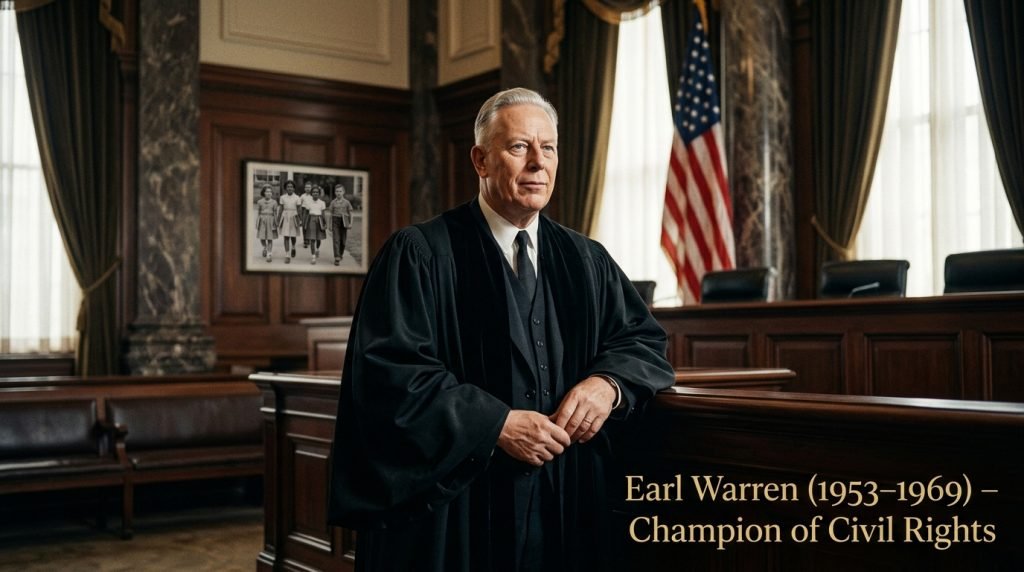
During his time as Chief Justice, the U.S. Supreme Court delivered decisions that reshaped civil rights, voting laws, education, and police procedures across America. His leadership was so influential that historians still refer to that period simply as:
“The Warren Court”
From ending racial segregation in schools to expanding constitutional protections for ordinary citizens, Warren helped redefine what equality and justice meant in the United States.
Earl Warren
- Born: March 19, 1891, Los Angeles, California
- Died: July 9, 1974, Washington, D.C.
- Political Party: Republican
- Governor of California: 1943–1953
- Chief Justice Tenure: 1953–1969
- Buried At: Arlington National Cemetery
A Humble Beginning
Earl Warren was born to Scandinavian immigrant parents and grew up in Bakersfield, California. His upbringing taught him discipline, hard work, and a strong sense of public service.
He later studied law at the University of California, Berkeley, beginning a career that would eventually place him at the center of American history.
Before becoming a judge, Warren worked as:
- Alameda County District Attorney
- California Attorney General
- Governor of California
As governor, he introduced major reforms in:
- Education
- Healthcare
- Infrastructure
However, one decision from this period would haunt him for the rest of his life.
A Dark Chapter: Japanese American Internment
During World War II, Warren supported the internment of Japanese Americans after the attack on Pearl Harbor.
Thousands of innocent Japanese American families were forced into camps.
Years later, Warren admitted this decision was a serious mistake and deeply regretted supporting it.
This experience would later shape his stronger commitment to civil liberties and constitutional rights.
Becoming Chief Justice
In 1953, President Dwight D. Eisenhower appointed Earl Warren as the 14th Chief Justice of the United States.
Many expected him to be a moderate conservative judge.
Instead, Warren led one of the most progressive and transformative courts in American history.
The Case That Changed America
The Warren Court’s most famous decision came in:
Brown v. Board of Education
At the time, racial segregation in public schools was legal in many parts of America.
The Court unanimously ruled that:
“Separate educational facilities are inherently unequal.”
This historic decision ended legal school segregation and became a major turning point in the American Civil Rights Movement.
Expanding Rights for Ordinary Citizens
Warren believed the Constitution should protect individuals from government abuse.
Under his leadership, the Supreme Court issued several landmark rulings.
Reynolds v. Sims
This case established the principle of:
“One person, one vote”
The ruling ensured voting districts had roughly equal populations, making representation more democratic.
Miranda v. Arizona
This decision required police to inform suspects of their constitutional rights before questioning them.
That’s why people arrested in America still hear:
“You have the right to remain silent…”
These became known as Miranda Rights.
The Warren Commission
After the assassination of John F. Kennedy in 1963, President Lyndon B. Johnson asked Warren to lead the investigation.
The investigation became known as:
Warren Commission
The Commission concluded that:
- Lee Harvey Oswald acted alone in the assassination.
Although the findings remain controversial, Warren was respected for his honesty and dedication to due process.
A Lasting Legacy
The Warren Court permanently changed American constitutional law.
Under Warren’s leadership, the Supreme Court became:
- A defender of civil rights
- A protector of voting equality
- A guardian of individual freedoms
Supporters praised him for advancing justice and equality.
Critics accused the Court of “judicial activism,” arguing it expanded judicial power too far.
But regardless of political opinion, few can deny Warren’s enormous impact on American society.
Final Thoughts
Earl Warren was more than a judge.
He was:
- A reformer
- A defender of civil liberties
- A leader during one of America’s most divided eras
His decisions helped move the United States closer to the ideals of equality and constitutional protection.
Even today, the influence of the Warren Court can still be seen in classrooms, courtrooms, elections, and everyday American life.
Leave a Reply