
John Marshall: The Chief Justice Who Built the Power of the U.S. Supreme Court
When people talk about the most influential judges in American history, one name always rises above the rest — John Marshall.
Before Marshall, the U.S. Supreme Court was seen as a relatively weak institution. But by the time he left office, it had become one of the most powerful pillars of American democracy.
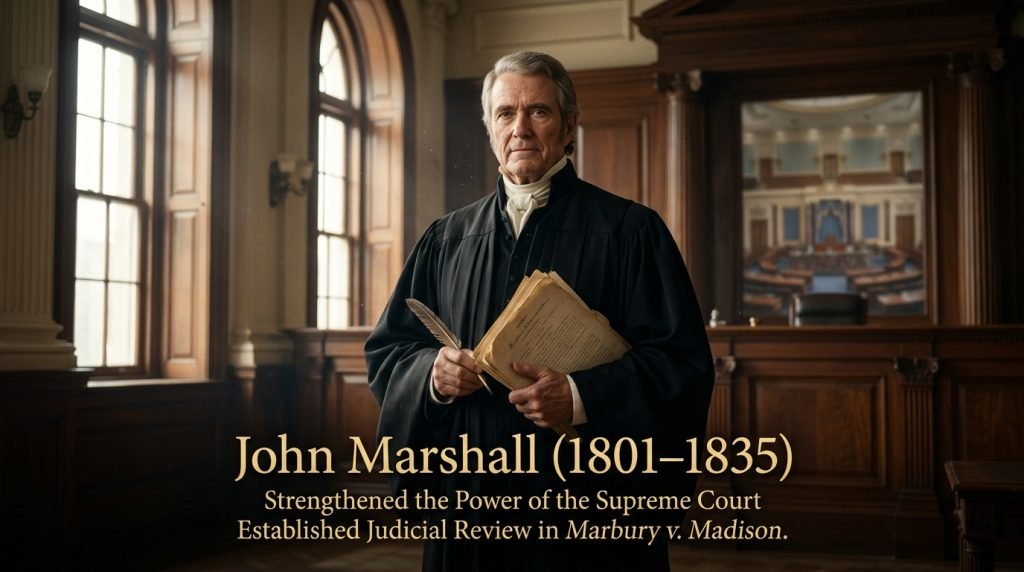
Serving as the fourth Chief Justice of the United States from 1801 to 1835, Marshall transformed constitutional law and forever changed the relationship between the federal government and the states.
Facts About John Marshall
- Born: September 24, 1755, Virginia
- Died: July 6, 1835, Philadelphia
- Position: Chief Justice of the United States
- Tenure: 1801–1835
- Appointed By: John Adams
- Most Famous Cases:
- Marbury v. Madison
- McCulloch v. Maryland
- Gibbons v. Ogden
A Childhood on the American Frontier
John Marshall was born in 1755 near Germantown, Virginia, in a large family with fifteen children. Life on the frontier was tough, but it helped shape his disciplined and determined personality.
As a young man, Marshall joined the American Revolutionary War and served under George Washington at the harsh winter camp of Valley Forge.
The experience deeply influenced his belief in national unity and a strong federal government.
From Soldier to Lawyer
After the war, Marshall briefly studied law at the College of William & Mary and quickly became a successful lawyer in Richmond, Virginia.
But Marshall wasn’t only interested in law — he also entered politics and became a leading member of the Federalist Party, which supported a stronger central government.
At a time when America was still young and politically divided, Marshall strongly defended the newly created U.S. Constitution.
The Road to the Supreme Court
Marshall gained national attention during the famous XYZ Affair, a diplomatic crisis between the United States and France. His calm and intelligent handling of the situation earned widespread respect.
Later, he served as Secretary of State under President John Adams.
In 1801, Adams appointed him as Chief Justice of the United States — a decision that would change American history forever.
The Decision That Made the Supreme Court Powerful
Marshall’s most famous ruling came in:
Marbury v. Madison
This case introduced one of the most important principles in American law:
Judicial Review
Marshall declared that the Supreme Court had the power to strike down laws that violated the Constitution.
The Court could now decide whether government actions were constitutional or not.
This single decision made the Supreme Court an equal branch of government alongside the President and Congress.
Strengthening Federal Power
Marshall continued expanding federal authority through other historic rulings.
McCulloch v. Maryland
In this case, Marshall ruled that states could not interfere with federal institutions, strengthening the power of the national government.
Gibbons v. Ogden
Here, he expanded Congress’s authority over interstate commerce, helping create a more unified national economy.
A Legacy That Still Shapes America
During his 34 years as Chief Justice, Marshall:
- Participated in over 1,000 court cases
- Wrote more than 500 legal opinions
- Helped define the balance between state power and federal power
More importantly, he established the judiciary as an independent and respected institution.
Why John Marshall Still Matters Today
Even nearly two centuries after his death, Marshall’s influence remains everywhere in American law.
Every time the U.S. Supreme Court reviews whether a law is constitutional, it traces back to Marshall’s vision.
He didn’t just serve on the Court —
he built the modern Supreme Court itself.
Final Thoughts
John Marshall was more than a judge.
He was:
- A war veteran
- A constitutional thinker
- A nation-builder
And above all, the man who transformed the Supreme Court into one of the most powerful judicial institutions in the world.
His decisions continue to shape American democracy to this day.
Leave a Reply