
Law of Torts Explained: Meaning, Elements, Defenses, and Types
1. Introduction
When we hear the word “law,” we often immediately think of police, courts, and criminals going to jail. However, a massive portion of the legal system is dedicated entirely to civil disputes between private individuals. This is where tortious liability comes into play.
Unlike criminal offenses, which are considered wrongs against society or the state, a tort is a civil wrong committed against an individual. The primary goal here is not to punish the wrongdoer with jail time, but rather to compensate the victim for the harm or loss they have suffered. This compensation usually takes the form of “unliquidated damages”—meaning the amount of money awarded is not pre-determined by an agreement, but is instead decided by the court based on the specific facts of the case.
2. Meaning of the Concept
To truly grasp the subject, we must first look at its linguistic roots. Understanding the true meaning of the Law of Torts requires looking back at its historical and etymological origins.
The word “tort” is of French origin, derived from the Latin word tortum, which translates to “twisted” or “crooked.” It implies conduct that is not straight or right; it is conduct that is twisted or wrongful.
- In English law, it is simply equivalent to a “wrong.”
- In Roman law, the equivalent term is delict.
- In Sanskrit, the closest equivalent is Jimha, which also means crooked.
Essentially, if a person’s behavior deviates from the standard expected of a reasonable person in a civilized society, and that deviation causes harm to someone else’s legal rights, a tort has been committed. It revolves around the fundamental principle that every person has certain basic legal rights (such as the right to personal safety, the right to property, and the right to a good reputation) and corresponding duties not to infringe on the rights of others.
3. Definitions by Famous Persons
Because this branch of jurisprudence is largely uncodified—meaning it is based heavily on judicial precedents and common law rather than a single written statute—it can be tricky to define. Various jurists have attempted to define the Law of Torts over the centuries, each bringing a unique perspective to its fundamental nature.
Here are the most widely accepted definitions by famous legal scholars:
Sir John Salmond
“It is a civil wrong for which the remedy is a common law action for unliquidated damages, and which is not exclusively the breach of a contract or the breach of a trust or other merely equitable obligation.”
Takeaway: Salmond highlights three key things: it is a civil wrong, the remedy is unliquidated damages, and it is entirely distinct from contract or trust breaches.
Sir Percy Henry Winfield
“Tortious liability arises from the breach of a duty primarily fixed by law; this duty is towards persons generally and its breach is redressible by an action for unliquidated damages.”
Takeaway: Winfield emphasizes that the duty is “fixed by law” (not by an agreement between parties) and is owed to people generally (like the duty not to punch a stranger), rather than specific individuals in a contract.
Sir Hugh Fraser
“It is an infringement of a right in rem of a private individual giving a right of compensation at the suit of the injured party.”
Takeaway: Fraser introduces the concept of right in rem (a right available against the whole world, such as the right to life or property), as opposed to a right in personam (a right against a specific person, like a debtor).
Sir Frederick Pollock
“An act which causes harm to a determinate person, whether intentionally or not, not being a breach of a duty arising out of a personal relation or contract, and which is either contrary to law, or an omission of a specific legal duty, or a violation of an absolute right.”
Takeaway: Pollock provides a highly detailed definition focusing on the act of causing harm and the violation of absolute rights.
4. Essential Elements
To establish a valid case in court, certain essential elements must be present under the Law of Torts. Simply suffering a loss is not enough to win a lawsuit; the plaintiff (the injured party) must prove the following three ingredients:
A. Wrongful Act or Omission
The defendant must have committed an act that they were legally forbidden from doing, or omitted (failed to do) an act they were legally bound to do.
- Example of an Act: Trespassing onto someone’s private farm.
- Example of an Omission: A municipal corporation failing to cover a manhole, leading to a pedestrian falling in.
B. Legal Damage (Injuria)
This is perhaps the most crucial element. There must be an infringement of a legal right. The courts recognize two important Latin maxims to explain this:
- Injuria Sine Damno (Injury without Damage):
This means the violation of a legal right without any actual physical or financial loss. This is actionable in court.
- Landmark Case: Ashby v. White (1703). The plaintiff was legally entitled to vote, but the returning officer wrongly prevented him from doing so. The candidate the plaintiff wanted to vote for won anyway, so there was no actual loss. However, the court ruled that his legal right to vote was violated, and therefore, he was entitled to compensation.
- Damnum Sine Injuria (Damage without Injury):
This means suffering actual financial or physical loss, but without the violation of any legal right. This is not actionable in court.
- Landmark Case: Gloucester Grammar School Case (1410). A rival schoolmaster set up a competing school right next to the plaintiff’s school, forcing the plaintiff to lower his fees significantly. The plaintiff suffered massive financial loss. However, the court ruled that setting up a lawful business is a right, and mere competition does not violate a legal right. The plaintiff lost the case.
C. Legal Remedy
The wrongful act must come under the category of wrongs for which a legal remedy exists. This is governed by the maxim Ubi jus ibi remedium—where there is a right, there is a remedy. If the law confers a right, it must also provide a mechanism to protect that right.
5. Types of Civil Wrongs
The Law of Torts categorizes civil wrongs into three main types based on the defendant’s mental state and the nature of the action. Let’s break them down in detail.
I. Intentional Wrongs
These occur when the defendant acts with the specific intent to cause harm or injury to the plaintiff. The wrongdoer knows what they are doing and intends the consequences. Common examples include:
- Battery: The intentional and direct application of physical force to another person without lawful justification. (e.g., punching someone).
- Assault: Creating a reasonable apprehension in the mind of the plaintiff that a battery is about to occur. (e.g., pointing a loaded gun at someone, even if you don’t fire).
- False Imprisonment: Completely restraining an individual’s liberty without lawful justification. The restraint must be absolute.
- Trespass to Land: Entering someone else’s property intentionally without permission. You do not need to cause damage to be liable for trespass.
- Defamation: Publishing a false statement that harms the reputation of the plaintiff. It is divided into Libel (written/permanent form) and Slander (spoken/transient form).
II. Negligence
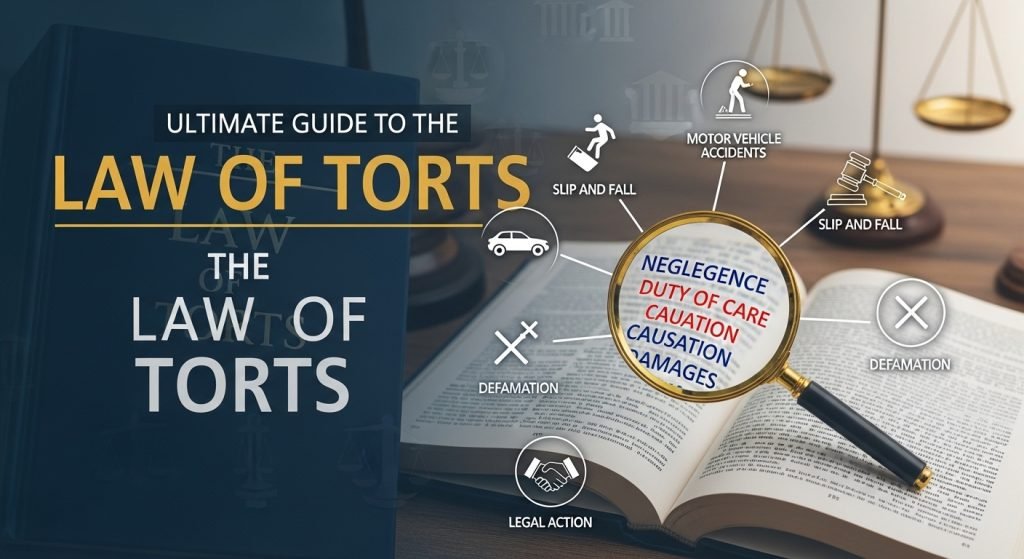
Negligence is the most common type of civil wrong. It occurs when a person fails to take reasonable care, resulting in damage or injury to another. It lacks intentional malice but involves carelessness. To prove negligence, one must show:
- Duty of Care: The defendant owed a legal duty to the plaintiff.
- Breach of Duty: The defendant failed to uphold that duty.
- Causation: The breach directly caused the injury.
- Damages: The plaintiff suffered legally recognizable harm.
- Landmark Case: Donoghue v. Stevenson (1932). Famous as the “snail in the ginger beer” case. A woman drank a ginger beer purchased by her friend and found a decomposed snail at the bottom of the opaque bottle. She fell violently ill. The House of Lords established the “Neighbour Principle,” stating that a manufacturer owes a duty of care to the final consumer of their product.
III. Strict Liability and Absolute Liability
In these cases, a person can be held liable for damages even if they were not negligent and had no intention to cause harm. Liability is attached simply because an inherently dangerous situation got out of hand.
- Strict Liability: Established in Rylands v. Fletcher (1868). If a person brings something dangerous onto their land, and it escapes and causes mischief, they are strictly liable. However, this rule has exceptions (like Acts of God).
- Absolute Liability: Established in India via the M.C. Mehta v. Union of India (Oleum Gas Leak case). Similar to strict liability, but with absolutely no exceptions. If a dangerous enterprise causes harm, they must pay.
6. General Defenses
Even if a plaintiff proves all the essential elements of a wrong, the defendant might still avoid liability. Under the Law of Torts, a defendant can use several general defenses to justify or excuse their actions.
A. Volenti Non Fit Injuria (Defense of Consent)
If a plaintiff voluntarily consents to suffer some harm, they cannot later sue for it. For example, a spectator sitting in the front row of a baseball game who gets hit by a flying ball cannot sue the batter, as they assumed the inherent risk by purchasing the ticket.
B. Plaintiff the Wrongdoer
If the plaintiff’s own illegal or wrongful act is the direct cause of their injury, they may be barred from claiming damages.
C. Inevitable Accident
An accident that could not possibly be prevented by the exercise of ordinary care, caution, and skill. Case example: Stanley v. Powell, where a bullet ricocheted off a tree and hit someone during a shooting party.
D. Act of God (Vis Major)
An extraordinary occurrence of circumstances strictly due to natural forces (like unprecedented earthquakes, floods, or tornadoes) without human intervention, which could not reasonably be anticipated.
E. Private Defense
The law permits the use of reasonable force to protect one’s person or property against an unlawful threat. However, the force used must be proportionate to the threat. You cannot use a shotgun to stop someone stealing an apple.
F. Necessity
Causing minor harm to prevent a much greater harm. For example, trespassing onto a neighbor’s property to put out a fire that threatens the whole neighborhood.
G. Statutory Authority
If an action is authorized by a legislature or parliament, any harm caused by it is not actionable. For instance, the noise and vibrations caused by trains operating on a legally authorized railway track cannot be sued for as a nuisance.
7. Differences: Tort vs. Crime vs. Contract
A common point of confusion for students and laypersons alike is how the Law of Torts differs from criminal law and the breach of contracts. The following comparison tables clarify these distinctions.
Tort vs. Crime
| Feature | Civil Wrong (Tort) | Crime |
| Nature of Wrong | Private wrong against an individual. | Public wrong against society/the state. |
| Initiation | The injured party (plaintiff) files a civil lawsuit. | The State (prosecution) files charges. |
| Remedy/Outcome | Compensation (damages) awarded to the victim. | Punishment (imprisonment/fines) for the offender. |
| Standard of Proof | Preponderance of the evidence (more likely than not). | Beyond a reasonable doubt (much stricter). |
| Intention | Intent is often irrelevant (except in specific cases). | Mens rea (guilty mind) is generally an essential element. |
Tort vs. Breach of Contract
| Feature | Civil Wrong (Tort) | Breach of Contract |
| Duty Created By | The law itself, imposed on society generally. | The agreement of the parties involved. |
| Nature of Duties | Duty is owed to persons generally (right in rem). | Duty is owed to a specific person (right in personam). |
| Damages | Unliquidated damages (decided by the court). | Liquidated damages (often predetermined in the contract). |
| Consent | Usually occurs without the victim’s consent. | Based entirely on mutual consent and free will. |
8. Remedies Available
The primary purpose of the Law of Torts is to provide a remedy to the aggrieved party. Without remedies, legal rights are nothing more than words on paper. Remedies are broadly classified into two categories: Judicial and Extra-Judicial.
I. Judicial Remedies
These are remedies granted by the courts of law.
- Damages: This is the most common remedy. It is monetary compensation paid by the defendant to the plaintiff. Damages can be:
- Nominal: A tiny amount awarded just to recognize that a right was violated (e.g., Ashby v. White).
- Compensatory: To put the plaintiff back in the position they were in before the wrong occurred.
- Exemplary/Punitive: Heavy financial penalties meant to punish the defendant and deter others from similar conduct.
- Injunctions: A court order commanding a person to do, or refrain from doing, a specific act. This is highly useful in cases of ongoing nuisance, such as ordering a factory to stop emitting toxic smoke into a residential area.
- Specific Restitution of Property: If someone is wrongfully dispossessed of their movable or immovable property, the court can order the property to be restored to its rightful owner.
II. Extra-Judicial Remedies
These are remedies that a person can take into their own hands, provided they act lawfully and do not use excessive force.
- Self-Defense: Protecting oneself from imminent harm.
- Expulsion of Trespasser: A lawful owner can use reasonable force to evict a trespasser from their property.
- Re-entry on Land: An owner wrongfully dispossessed of their land may step back onto it to reclaim it, peacefully.
- Abatement of Nuisance: An occupier of land can cut off the overhanging branches of a neighbor’s tree that are causing a nuisance, provided they give notice first and do not trespass.
9. Conclusion
Understanding the complexities of civil wrongs empowers individuals to protect their rights and seek justice when those rights are violated. Mastering the Law of Torts is essential for any law student or practitioner, as it forms the very bedrock of civil litigation and everyday interpersonal duties. From historical concepts rooted in Roman and English history to modern applications in corporate negligence and strict liability, this branch of jurisprudence continually evolves to meet the changing needs of a dynamic society.